
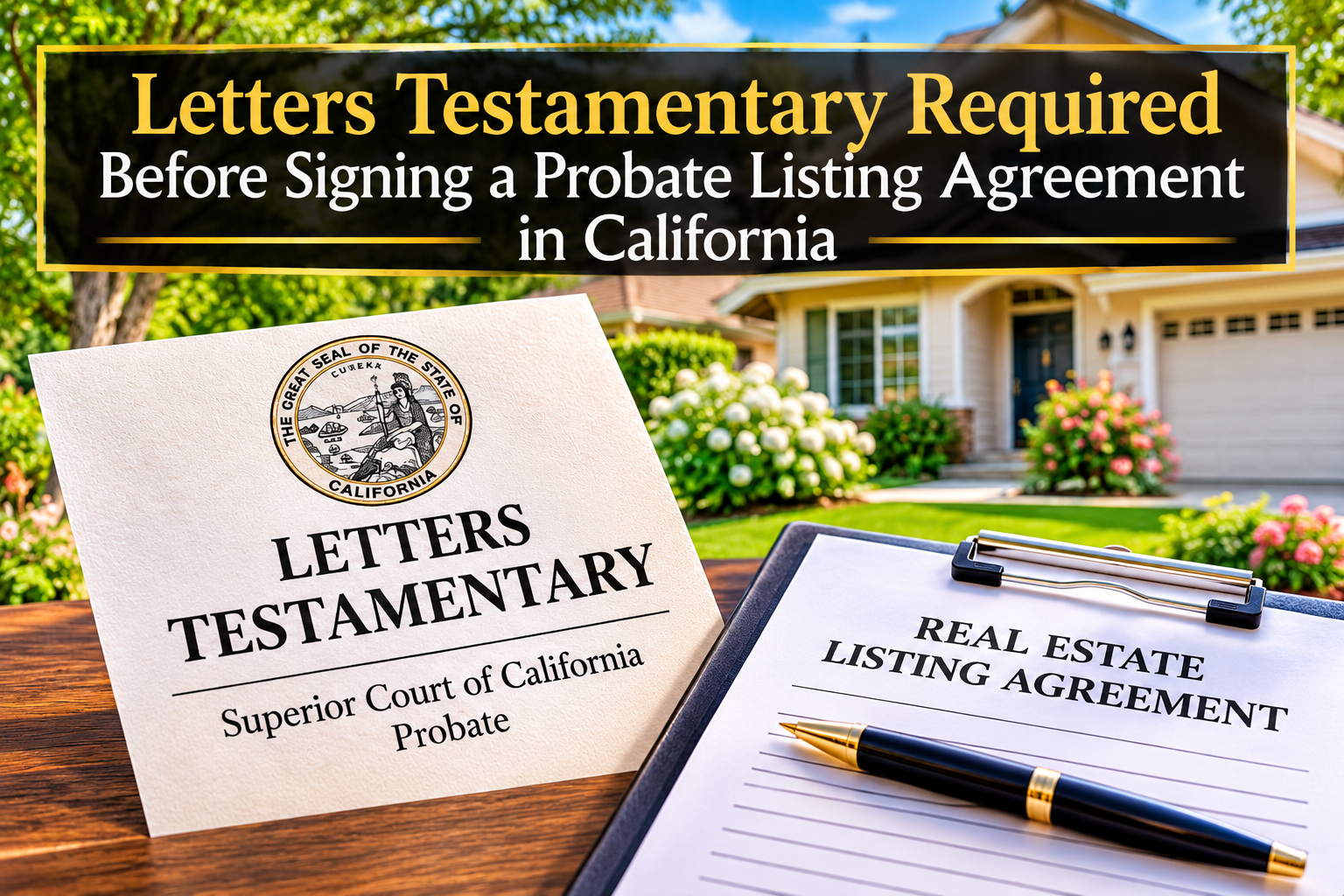
Originally published in 2022. Updated November 2, 2026, to clarify California probate authority, Letters Testamentary, and real property sale procedures.
When someone dies leaving real property, the person named as executor in the will may assume they can immediately hire a real estate broker and sell the home. However, being named as executor in a will is not the same as having court-issued authority to act on behalf of the probate estate.
Before signing a probate listing agreement, it is important to establish who has the legal authority to represent the estate and what powers the probate court has granted.
In California, that authority is generally documented through Letters Testamentary or Letters of Administration, issued following the court’s appointment of a personal representative.
I have encountered situations where the urgency to sell a home conflicted with the requirements of probate administration. One particular experience illustrates why understanding these documents matters.
What Are Letters Testamentary in California Probate?
Letters Testamentary are court-issued documents identifying an executor who has been appointed to administer a deceased person’s estate.
A person may be nominated as executor in a will, but that nomination alone does not establish the legal authority to act for the probate estate.
Generally, the probate court must appoint the executor, and the required steps for issuing Letters must be completed.
The Letters serve as evidence of the personal representative’s authority. They are commonly requested by financial institutions, title companies, and other parties conducting business with the estate.
For real estate transactions, reviewing the Letters is an important part of determining whether the individual proposing to sign a listing agreement has the necessary authority.
Letters Testamentary vs. Letters of Administration: What’s the Difference?
The terminology depends on the circumstances of the probate proceeding.
Letters Testamentary
Letters Testamentary are generally issued when the probate court appoints an executor under a will.
Letters of Administration
Letters of Administration are generally issued when the court appoints an administrator, often when the deceased person did not leave a valid will naming an executor who can serve.
Other appointments may involve Letters of Administration With Will Annexed or Letters of Special Administration.
The California Judicial Council uses Form DE-150, Letters (Probate), which includes the different types of appointments.
Regardless of the title, the essential question for a real estate broker remains the same:
Has the individual been appointed by the court, and what authority has been granted?
Can You Sign a Probate Listing Agreement Before Receiving Letters Testamentary?
A person who merely expects to become the executor or administrator generally should not sign a listing agreement on behalf of the estate before obtaining the necessary legal authority.
There is an important distinction between preparing for a sale and formally committing the estate to a real estate transaction.
Before Letters are issued, a prospective personal representative may be able to gather information about the property’s condition, discuss marketing options, request a comparative market analysis, and interview real estate brokers.
Those preliminary steps can help the family prepare.
However, signing a listing agreement on behalf of the probate estate requires appropriate authority, and a real estate broker should verify that authority before proceeding.
The same care is necessary when considering offers, negotiating agreements, and moving toward closing.
A Real-Life Example: When the Need for a Quick Sale Complicated Probate
Several years ago, I received a telephone call from a woman I will call Sheila to protect her privacy.
Sheila lived outside Santa Clara County, my real estate service area.
She was distressed about her circumstances and needed to sell a home belonging to a deceased family member. During our conversation, she became emotional while explaining the financial difficulties she was facing.
She wanted a quick sale.
As I listened, it became apparent that she needed assistance understanding how to begin the probate process.
Helping Sheila Find Probate Legal Assistance
Although I do not provide legal referrals outside Santa Clara County as part of my regular services, Sheila’s circumstances prompted me to make an exception.
I spent several hours researching probate attorneys in her county, making telephone calls, and sending emails.
Some attorneys responded. Others did not.
Eventually, I located an attorney willing to consider the matter, despite the relatively modest value of the estate.
There were filing costs and other expenses that Sheila needed to address before proceeding. She explained that she would need time to obtain the necessary funds.
Once she had the money, she arranged an appointment with the law firm.
Sheila also told me that other heirs were willing to relinquish their interests so that she could receive the estate’s assets.
However, an understanding among family members does not, by itself, establish court-appointed authority to sell probate real property.
The Urgency to Sell the Property
Sheila continued to emphasize that she wanted the property sold quickly.
I explained that I would be happy to recommend an experienced probate real estate agent in her area.
She asked whether she was required to use the agent I recommended.
Absolutely not.
Choosing a real estate broker is an important decision. My offer was simply to help her locate a professional familiar with probate property sales in her local market.
Following that conversation, Sheila stopped communicating with me.
I respected her decision and hoped she would be able to resolve her circumstances.
What I Discovered in the Multiple Listing Service
Later, the real estate agent I had considered recommending contacted me to ask whether there had been any developments.
Because I had not heard from Sheila, I checked the local Multiple Listing Service (MLS).
The property was listed for sale.
More importantly, its status indicated that it was already under contract.
The MLS remarks included the notation “pending court approval.”
Based on the information available to me at that time, I had concerns about whether the required probate authority had been obtained before the agreements were signed.
I was not involved in that transaction, and I do not know its ultimate outcome.
I cannot say whether the sale eventually closed, whether the court approved it, or whether additional steps were taken to address the transaction.
What the experience illustrates is the importance of verifying a personal representative’s authority before entering into agreements involving probate real property.
The desire for a quick sale is understandable, particularly when a family is experiencing financial pressure. But urgency does not eliminate the requirements of probate administration.
What Authority Do Letters Give an Executor or Administrator?
Letters establish the court-appointed personal representative’s authority, subject to any restrictions, limitations, and applicable legal requirements.
However, receiving Letters does not automatically mean that every real estate transaction can proceed without additional steps.
In California, the personal representative’s authority may depend on whether the court granted powers under the Independent Administration of Estates Act (IAEA).
Full Authority Under the IAEA
When a personal representative has full authority under the IAEA, the representative may generally sell real property without a court confirmation hearing, provided the applicable requirements are satisfied.
A Notice of Proposed Action may be required, allowing interested persons an opportunity to object before the transaction proceeds.
Full authority does not eliminate the personal representative’s fiduciary responsibilities or every procedural requirement.
Limited Authority Under the IAEA
When a personal representative has limited authority, a sale of real property generally requires court supervision and confirmation.
The transaction may involve additional procedures, including a court hearing and the possibility of overbids.
These requirements can affect the marketing strategy, contract terms, and anticipated closing timeline.
For a more detailed explanation, read California’s Independent Administration of Estates Act.
What Happens If Someone Signs a Listing Agreement Without Probate Authority?
Entering into a listing agreement or purchase agreement before obtaining the required authority can create legal and practical complications.
Potential concerns include whether the person had authority to bind the estate, whether the transaction can proceed as contemplated, and whether additional court action is necessary.
The consequences depend on the circumstances, the documents signed, and applicable law.
It would be inappropriate to assume that every agreement signed before the issuance of Letters is automatically void or that every such transaction will be rejected by the probate court.
Those are legal questions for the estate’s attorney and, when necessary, the court.
From a real estate perspective, the better approach is to verify authority before asking the personal representative to sign.
That protects the integrity of the transaction and helps avoid preventable delays.
Why Real Estate Brokers Should Review the Letters
Probate real estate transactions involve more than obtaining a signature on a listing agreement.
The broker needs to understand who is authorized to act for the estate and whether the proposed sale involves special requirements.
Before proceeding with a probate listing, I review the relevant court-issued documents to understand the representative’s authority.
Depending on the circumstances, this may involve confirming:
- The name of the court-appointed personal representative.
- Whether Letters have been issued.
- Whether the appointment involves any limitations or special conditions.
- Whether full or limited IAEA authority has been granted.
- Whether the real property sale requires court confirmation.
When legal questions arise, they belong with the estate’s probate attorney.
My responsibility as the real estate broker is to manage the real estate aspects of the transaction within the scope of my professional role.
Can You Prepare a Probate Home for Sale While Waiting for Letters?
Yes. There are useful preliminary steps that may be appropriate while the probate appointment is pending.
A prospective personal representative can begin gathering information about the property, identifying potential maintenance concerns, and consulting with a probate real estate specialist.
My Probate Property Walk-Through Checklist provides a practical starting point for evaluating the property’s condition and identifying matters that may need attention.
Depending on the circumstances and the advice of the probate attorney, preparation may include discussing the property’s likely market value, whether repairs would be worthwhile, and the advantages of an as-is sale.
For additional guidance, read Selling a Probate Home As-Is vs. Making Repairs.
However, preparing a property for sale is different from exercising legal authority over estate assets.
Before authorizing work, disposing of belongings, signing agreements, or making other decisions affecting estate property, the individual should confirm what actions are permitted.
The goal is to be prepared to move forward efficiently once the appropriate authority is established.
Why Experience Matters in a California Probate Real Estate Sale
Probate sales involve legal procedures that do not ordinarily arise in traditional residential real estate transactions.
The personal representative may live outside the area, the property may require extensive preparation, and family members may have different expectations about the sale.
For personal representatives who do not live nearby, managing probate property from a distance can introduce additional logistical challenges.
The estate may also be subject to court confirmation, notice requirements, or other conditions that affect the transaction.
An experienced probate real estate broker understands the importance of coordinating the real estate process with the personal representative and the estate’s attorney.
That coordination can help establish realistic expectations and reduce avoidable complications.
For additional information about the probate process, visit Probate Real Estate Services.
Putting It All Together
Letters Testamentary and Letters of Administration are essential documents in California probate administration.
They establish the court-appointed personal representative’s authority, while the nature and extent of that authority determine how certain transactions may proceed.
Sheila’s experience remains a reminder that the pressure to sell quickly should not overshadow the need to follow the probate process.
Although I never learned what happened to her transaction, the situation reinforced a principle I follow in my own practice:
Verify the authority to act before signing a probate real estate listing agreement.
Taking that step at the beginning can help prevent complications later.
Need Help Selling Probate Real Property in Santa Clara County?
I am an independent California Real Estate Broker and Certified Probate Real Estate Specialist (CPRES), specializing in the sale of probate, trust, and conservatorship real property throughout Santa Clara County.
My background includes probate and estate planning paralegal experience, along with specialized education in fiduciary management.
I work with court-appointed personal representatives and their probate attorneys to manage the real estate transaction with attention to the requirements that can affect the sale.
Learn more about my experience and qualifications or contact me to discuss the sale of probate real property in Santa Clara County.
Disclaimer: This article is provided for general educational purposes and is not legal advice. Probate procedures and the authority granted to a personal representative depend on the circumstances of each estate. Consult a qualified California probate attorney regarding legal questions or court requirements.