
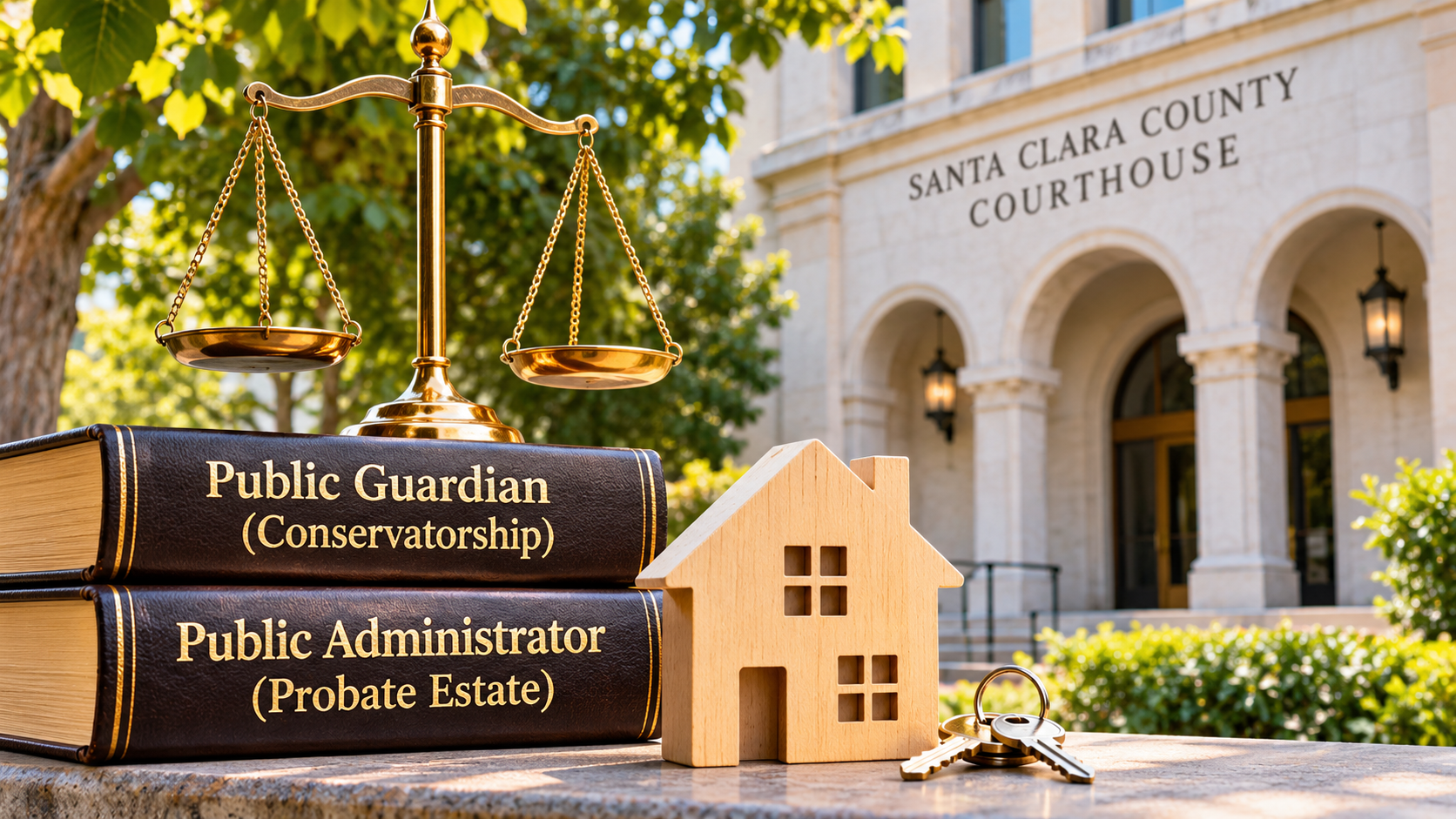
Editor’s Note: Originally published August 4, 2022. This article has been updated on November 2, 2026, to clarify the distinct responsibilities of the Public Guardian and Public Administrator and provide additional information about real property sales in Santa Clara County.
When someone dies without an available person to administer their estate, or when an adult needs court-appointed assistance managing their affairs, a county agency may become involved.
In Santa Clara County, the Public Guardian and Public Administrator perform different functions. Both may become responsible for real property, but the legal authority and procedures governing a sale depend on the appointment and circumstances.
Understanding these distinctions is particularly important when real property must be sold as part of probate administration or a conservatorship.
What Is the Difference Between a Public Guardian and a Public Administrator?
Although the terms are sometimes used interchangeably, the Public Guardian and Public Administrator serve different purposes.
Public Guardian
The Public Guardian may serve as a court-appointed conservator for an adult who needs assistance managing personal care, financial affairs, or both, depending on the type of conservatorship and authority granted.
A probate conservatorship may involve responsibility for the conservatee’s personal needs, estate, or both.
A Lanterman-Petris-Short (LPS) conservatorship operates under a different legal framework and primarily concerns qualifying mental health circumstances.
The authority to manage or sell real property depends on the appointment, applicable law, and any necessary court approval.
Public Administrator
The Public Administrator may administer the estate of a deceased person when no eligible or willing person is available to serve, or under other circumstances authorized by California law.
For example, a person may die without a will and without an available family member to petition for appointment.
However, dying without a will does not automatically mean the Public Administrator will administer the estate.
The probate court determines the appropriate appointment under applicable law.
Once appointed, the Public Administrator has responsibilities associated with administering the estate, which may include managing and selling real property.
When Does the Santa Clara County Public Guardian Become Involved?
A Public Guardian may be appointed when an adult requires a conservator and an appropriate private individual or professional is unavailable or unsuitable.
Depending on the court’s orders, responsibilities may include protecting assets, managing financial obligations, arranging necessary services, and overseeing real property.
When a conservatee owns a home, decisions about maintaining, retaining, or selling the property must be made within the conservator’s legal authority.
The sale of real property in a conservatorship is not automatically governed by the same procedures as a probate estate sale.
The applicable requirements should be reviewed with the attorney handling the conservatorship.
For additional information, visit our Conservatorship Resources.
When Does the Santa Clara County Public Administrator Become Involved?
The Public Administrator may become involved when a deceased person’s estate requires administration and no appropriate person is available to assume that responsibility.
Circumstances may include:
- No available or willing person with priority to administer the estate.
- A named executor who is unable or unwilling to serve.
- A court appointment under other circumstances authorized by law.
The Public Administrator does not simply take ownership of the deceased person’s property.
Rather, the office administers the estate under the legal authority granted through the probate proceeding.
Responsibilities may include identifying assets, protecting real property, addressing creditor claims, coordinating estate expenses, and arranging a sale when appropriate.
How Are Public Guardian and Public Administrator Properties Sold?
The sale process depends on which office is involved, the legal authority granted, and the requirements applicable to the particular property.
A real estate broker may be retained to market the property, coordinate showings, provide information to prospective buyers, and assist with the transaction.
However, buyers and their agents should not assume that every county-administered sale follows identical procedures.
Some sales may involve specific offer submission instructions, designated deadlines, required documents, or court approval.
Offer Submission Requirements
A property offered for sale by a county-appointed fiduciary may have instructions that differ from those of a conventional residential transaction.
For example, the listing broker may specify:
- Required purchase agreement documents.
- Offer submission deadlines.
- Deposit requirements.
- Financing or proof-of-funds documentation.
- Property condition and sale terms.
- Whether the offer is subject to court confirmation.
Where sealed bids are required, buyers must follow the instructions established for that particular sale.
Sealed bids should not be assumed to be a universal requirement for every Public Guardian or Public Administrator sale.
Likewise, an offer is not necessarily selected based solely on the highest purchase price. The fiduciary must consider the applicable legal requirements and the terms and reliability of the proposed transaction.
Court Confirmation and Overbidding
Some sales require confirmation by the probate court.
When court confirmation applies, an accepted offer remains subject to the court’s approval.
At the confirmation hearing, other qualified buyers may have an opportunity to submit a higher offer under California’s probate overbid rules.
The minimum qualifying overbid is calculated under California Probate Code §10311.
The process can differ substantially from a sale conducted by an executor or administrator with full authority under the Independent Administration of Estates Act (IAEA).
For a detailed explanation, including an actual Santa Clara County court hearing example, read California Probate Sale Overbid Process.
How Does a County-Administered Sale Differ From a Private Probate Sale?
In a privately administered probate estate, a court-appointed executor or administrator may receive full or limited authority under the IAEA.
With full authority, a personal representative can generally sell real property without court confirmation after satisfying the applicable legal requirements, including notice requirements when necessary.
With limited authority, court confirmation is generally required.
A sale involving the Public Administrator must also be evaluated according to the authority granted and any applicable county procedures.
A sale involving a Public Guardian acting as conservator may be subject to different conservatorship requirements.
The important point is that the identity of the fiduciary alone does not establish every requirement governing the transaction.
For additional information, read about the Independent Administration of Estates Act.
What Should Buyers Know About These Properties?
Buyers interested in a property offered by the Public Guardian or Public Administrator should carefully review the listing information and instructions.
These transactions may involve additional documents, court requirements, or timelines.
Prospective buyers should also evaluate the property’s condition and understand any limitations on investigations, contingencies, or repairs.
A county-administered sale does not automatically mean the property will sell below market value.
The purchase price depends on the property, market conditions, competing offers, and applicable sale procedures.
Buyers should work with their own qualified real estate representative and seek legal advice when appropriate.
Why Experience With Probate Real Estate Matters
Probate and conservatorship real property transactions require attention to legal authority, documentation, property condition, marketing, and the procedures applicable to the sale.
Effective coordination among the authorized fiduciary, estate attorney, real estate broker, and escrow company can help reduce avoidable delays.
In Santa Clara County, local market knowledge is also important when evaluating the property’s value and developing an appropriate marketing strategy.
Although the Public Guardian and Public Administrator have different responsibilities, both may face the practical challenges associated with protecting and selling real property.
Need Assistance Selling Probate or Conservatorship Real Property in Santa Clara County?
I am an independent California Real Estate Broker and Certified Probate Real Estate Specialist (CPRES), specializing in representing sellers of probate, trust, and conservatorship real property throughout Santa Clara County.
My background includes probate and estate planning paralegal experience, professional fiduciary education, and extensive real estate experience assisting court-appointed personal representatives and trustees.
I do not serve as a listing broker for the Santa Clara County Public Guardian or Public Administrator. My practice focuses on representing other authorized sellers of probate, trust, and conservatorship real property.
If you have been appointed executor, administrator, trustee, or conservator and are considering selling real property, I welcome the opportunity to discuss your real estate needs.
Learn more about my experience and qualifications or contact me to arrange a consultation.
Disclaimer: This article is provided for general educational purposes and does not constitute legal advice. The responsibilities of public fiduciaries, court-appointed personal representatives, and conservators depend on applicable law, the nature of the appointment, and court orders. Consult a qualified California attorney regarding specific legal requirements.